
You do not have to be a professional athlete to benefit from a sports physiotherapy assessment.
Maybe your knee starts hurting every time you run. Your ankle still does not feel stable after a sprain. Your shoulder bothers you when you serve, throw, swim, or lift. Or perhaps the pain is gone, but you are not confident that you are ready to return to your sport.
A sports physiotherapy assessment is designed to look beyond the sore area and understand how the injury is affecting the movements and demands that matter to you.
At South Simcoe Physiotherapy, that means understanding not only where it hurts, but also what sport you play, how you train, what movements cause problems, and what you need your body to be able to do before you return.
Summary
A sports physiotherapy assessment may include:
- a discussion about your injury, sport, training and goals
- assessment of movement and joint mobility
- strength testing
- balance and coordination testing when relevant
- functional movements such as squatting, jumping or landing
- sport-specific testing when appropriate
- an explanation of the findings
- a personalized rehabilitation and return-to-sport plan
The exact assessment will be different for every athlete and every injury.
Index
- What Is a Sports Physiotherapy Assessment?
- What Happens During Your Initial Sports Physio Assessment?
- Your Injury, Training and Sports History
- Movement, Strength and Mobility Testing
- Sport-Specific Testing and Functional Assessment
- Will Your Physiotherapist Assess How You Run, Jump or Move?
- How Long Does a Sports Physiotherapy Assessment Take?
- What Should You Wear and Bring?
- What Happens After the Assessment?
- When Should an Athlete Book a Sports Physiotherapy Assessment?
- Sports Physiotherapy Assessments in Alliston and Tottenham
What Is a Sports Physiotherapy Assessment?
A sports physiotherapy assessment is an evaluation of an injury or movement problem with your specific sport and activity goals in mind.
A regular physiotherapy assessment and a sports assessment share many of the same fundamentals. Your physiotherapist will listen to your history, examine the painful or injured area, assess movement and strength, and determine which factors may be contributing to the problem.
The difference is often in where the assessment goes next.
If your goal is simply to walk comfortably again after an ankle sprain, your assessment may focus primarily on everyday function. If your goal is getting back to competitive soccer, hockey, volleyball, running, tennis or another sport, the demands become very different.
Running, jumping, cutting, landing, throwing and rapidly changing direction require much more than being pain-free while walking around the house.
That is why sports rehabilitation needs to consider what your body will actually have to do when you return.
For a broader explanation of the role physiotherapy can play in athletic injuries, South Simcoe also has a guide to what sports physiotherapy involves. The Canadian Physiotherapy Association's Sport Physiotherapy Canada division also identifies functional return-to-sport training and progressive exercise as important parts of sports physiotherapy.
What Happens During Your Initial Sports Physio Assessment?
Your first appointment usually begins with a conversation.
Before asking you to squat, jump or perform a strength test, your physiotherapist needs to understand what happened.
You may be asked:
- When did the problem begin?
- Was there a specific injury?
- Where do you feel the symptoms?
- Which movements make the problem better or worse?
- Have you had this injury before?
- Have you changed your training recently?
- What sport and position do you play?
- How frequently do you train or compete?
- What level were you performing at before the injury?
- What are you trying to return to?
That final question matters.
“Getting better” means different things to different people.
For one athlete, the goal may be jogging five kilometres without knee pain. For another, it may be returning to competitive hockey. Someone else may need to jump repeatedly in volleyball, sprint on a soccer field, serve in tennis, or lift heavy weights.
Those goals help shape the assessment.
If you want a broader overview of a typical first visit, see our guide to what to expect at your first physiotherapy appointment. South Simcoe's current assessment process already includes history, physical examination and individualized treatment planning.
Your Injury, Training and Sports History
An injury does not always come from one dramatic event.
Sometimes there is an obvious moment: you roll an ankle, collide with another player or feel something pull during a sprint.
Other sports injuries develop gradually.
A runner might increase weekly mileage too quickly. A tennis player may suddenly play several matches after a quieter winter. A hockey player might notice groin pain after adding more practices. A recreational athlete may start a new sport and go from very little activity to several sessions a week.
That is why your training history can be just as important as your injury history.
Your physiotherapist may ask about recent changes in:
- training volume
- training intensity
- playing surface
- footwear or equipment
- strength training
- competitions or tournaments
- recovery between sessions
- previous injuries
This information can help build a clearer picture of why the problem developed and what may need to change during recovery.

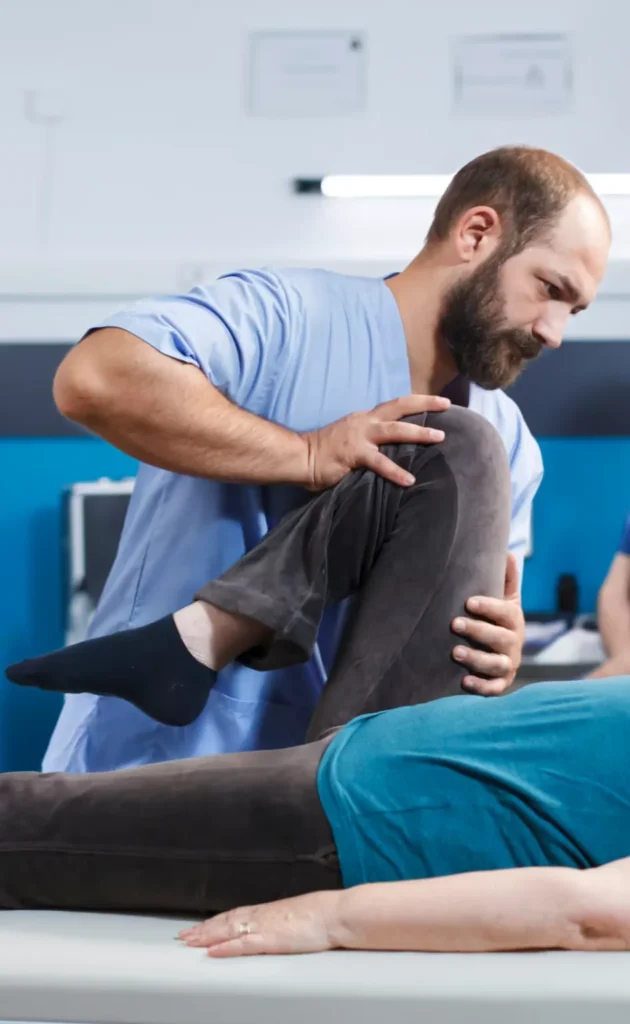
Movement, Strength and Mobility Testing
Once the history is clear, the physical part of the sports physiotherapy assessment begins.
There is no single set of tests that every athlete needs.
A knee injury may require a very different assessment from a shoulder injury. An ankle sprain will not be tested in the same way as a hamstring strain.
Depending on the problem, your physiotherapist may look at joint range of motion, muscle strength, flexibility, balance, coordination and how different parts of the body work together during movement.
For example, knee pain during sport does not automatically mean that the assessment should look only at the knee. Hip strength, ankle mobility, balance, training load and movement control may also be relevant.
The point is not to perform as many tests as possible.
The goal is to choose tests that help explain your symptoms and determine what needs to improve before you return to your activity.
Sport-Specific Testing and Functional Assessment
This is where a sports assessment can become much more specific.
Being able to perform a basic movement in the clinic does not necessarily mean you are ready for the demands of a game or competition.
Depending on your sport and stage of recovery, your physiotherapist may eventually assess movements such as:
- single-leg squatting
- stepping
- jumping and landing
- hopping
- accelerating and slowing down
- changing direction
- reaching or throwing
- repeated movements under fatigue
Not all of these tests belong in your first appointment.
If you have a fresh injury, significant pain or limited movement, high-level testing may not yet be appropriate. More demanding tests can be added later as rehabilitation progresses.
South Simcoe's recent ankle-sprain recovery example illustrates this progression well: rehabilitation moved from mobility and strength work into hopping, lateral movement, agility, acceleration and direction changes before return to hockey.
That progression matters because the question changes over time.
Early on, the question may be:
“What is injured and what can we safely start doing?”
Later, it becomes:
“Are you ready for the demands of your sport?”
Will Your Physiotherapist Assess How You Run, Jump or Move?
If the movement is relevant to your symptoms or your sport, yes, it may be part of the assessment.
A runner with recurring knee pain, for example, may benefit from having their running pattern assessed rather than only testing the knee on a treatment table.
South Simcoe offers a dedicated Running Assessment and Gait Analysis service in Alliston that can examine factors such as running form, cadence, foot strike, mobility, strength and other biomechanical considerations.
For athletes in other sports, the relevant movement may be very different.
A volleyball player may need to jump and land. A soccer player may need to run and change direction. A golfer may have difficulty rotating. A racquet-sport athlete may have symptoms during repeated overhead movement.
The assessment should reflect your sport, not a generic exercise checklist.
How Long Does a Sports Physiotherapy Assessment Take?
The time required depends on the complexity of the problem and what needs to be assessed.
At South Simcoe Physiotherapy, a typical initial physiotherapy assessment is approximately 45 minutes. More complex assessments, including running, vestibular and concussion-related assessments, may be approximately 60 minutes.
A sports injury does not automatically require every possible test during the first appointment.
Your physiotherapist may complete the most relevant assessment first and add more advanced functional or return-to-sport testing later, once your injury can safely tolerate it.
You can read more about appointment timing in our guide to how long a physiotherapy appointment typically takes.
What Should You Wear and Bring?
Wear clothing that allows you to move comfortably and gives your physiotherapist access to the area being assessed.
For a knee, ankle, hip or running-related problem, athletic shorts are usually helpful. For a shoulder problem, a T-shirt, tank top or similar clothing may make the assessment easier.
South Simcoe also recommends comfortable clothing appropriate to the area being examined.
For a sports assessment, it can also make sense to bring equipment that is relevant to your problem.
For example, a runner may want to bring their usual running shoes. If there is a particular brace or support you have been using, bring that as well.
If you have relevant imaging reports, surgical instructions or information from another healthcare professional, those may also be useful.
And know what you want to achieve.
“Return to soccer without worrying about my ankle” gives your physiotherapist much more useful information than simply saying, “I want the pain gone.”
What Happens After the Assessment?
The assessment should lead to a plan.
Your physiotherapist will explain what they found, what they think may be contributing to the problem and what they recommend doing next.
Depending on the injury, your plan may include a combination of:
- exercises to improve strength or mobility
- gradual changes to training
- activity modifications
- manual therapy
- balance or coordination exercises
- sport-specific rehabilitation
- progressive return-to-running or return-to-sport work
The plan should also change as you improve.
An exercise that is appropriate shortly after an ankle sprain will eventually stop being challenging enough for someone trying to return to hockey or soccer. The same applies to knee, shoulder and muscle injuries.
A good rehabilitation program gradually closes the gap between what you can do today and what your sport requires you to do.
For some tendon-related knee problems, your physiotherapist may also discuss whether treatments such as shockwave therapy for knee pain are appropriate as part of the overall plan.
When Should an Athlete Book a Sports Physiotherapy Assessment?
You do not necessarily have to wait until an injury completely stops you from playing.
An assessment may be useful when pain keeps returning during the same activity, an old injury still affects performance, you cannot return to your normal training level, or something simply does not feel right when you run, jump, throw or change direction.
It can also be worth getting assessed if an injury seems to have “healed” but strength, confidence or stability has not returned.
South Simcoe's sports injury prevention content makes the same practical point: persistent joint pain, swelling, loss of strength or movement, and pain that worsens with activity are signs that an assessment may be worthwhile.
One important exception is a suspected concussion. Concussion assessment involves additional considerations and should not be treated like a routine muscle or joint injury. South Simcoe provides dedicated concussion assessment and rehabilitation services, including symptom, balance, exercise and return-to-sport considerations.
Sports Physiotherapy Assessments in Alliston and Tottenham
Sports injuries are not only a problem for elite athletes.
They happen to youth athletes, competitive players, runners, weekend hockey players, gym members, golfers, pickleball players and people who simply want to stay active.
At South Simcoe Physiotherapy, assessments and treatment are provided one-on-one by registered physiotherapists. The goal is to understand your injury, the activities that matter to you and what your body needs to do to get you back there.
A sports physiotherapy assessment is the starting point.
It helps answer three important questions:
- What is limiting you now?
- What does your sport require from you?
- What needs to improve before you are ready to return?
If an injury is keeping you from training, competing or enjoying your sport, contact South Simcoe Physiotherapy to book an assessment in Alliston or Tottenham.
FAQs
What does a sports physiotherapist assess?
The assessment depends on the injury and sport. It may include joint mobility, muscle strength, flexibility, balance, coordination, functional movement and eventually sport-specific tasks such as running, jumping, landing or changing direction.
Do I need to be injured to have a sports physiotherapy assessment?
Not necessarily. Athletes may also seek assessment because of recurring discomfort, difficulty progressing their training, concerns about an old injury or problems that appear only during particular sports movements.
Will I have treatment during the first sports physiotherapy appointment?
Possibly. The amount of treatment during the first appointment depends on how much assessment is required. More complex injuries may require most of the first visit to understand the problem and establish an appropriate plan. South Simcoe takes the same approach with its general initial physiotherapy assessments.
Should I bring my running shoes or sports equipment?
If the equipment is directly related to the problem, bring it. Running shoes are particularly useful when you are being assessed for a running-related concern.
How do I know when I am ready to return to sport?
Being pain-free is only one consideration. Depending on the injury and sport, your physiotherapist may look at strength, movement, balance, sport-specific tasks and your ability to tolerate progressively greater training demands before recommending a return. Sport Physiotherapy Canada specifically includes functional return-to-sport training among sport physiotherapy competencies.